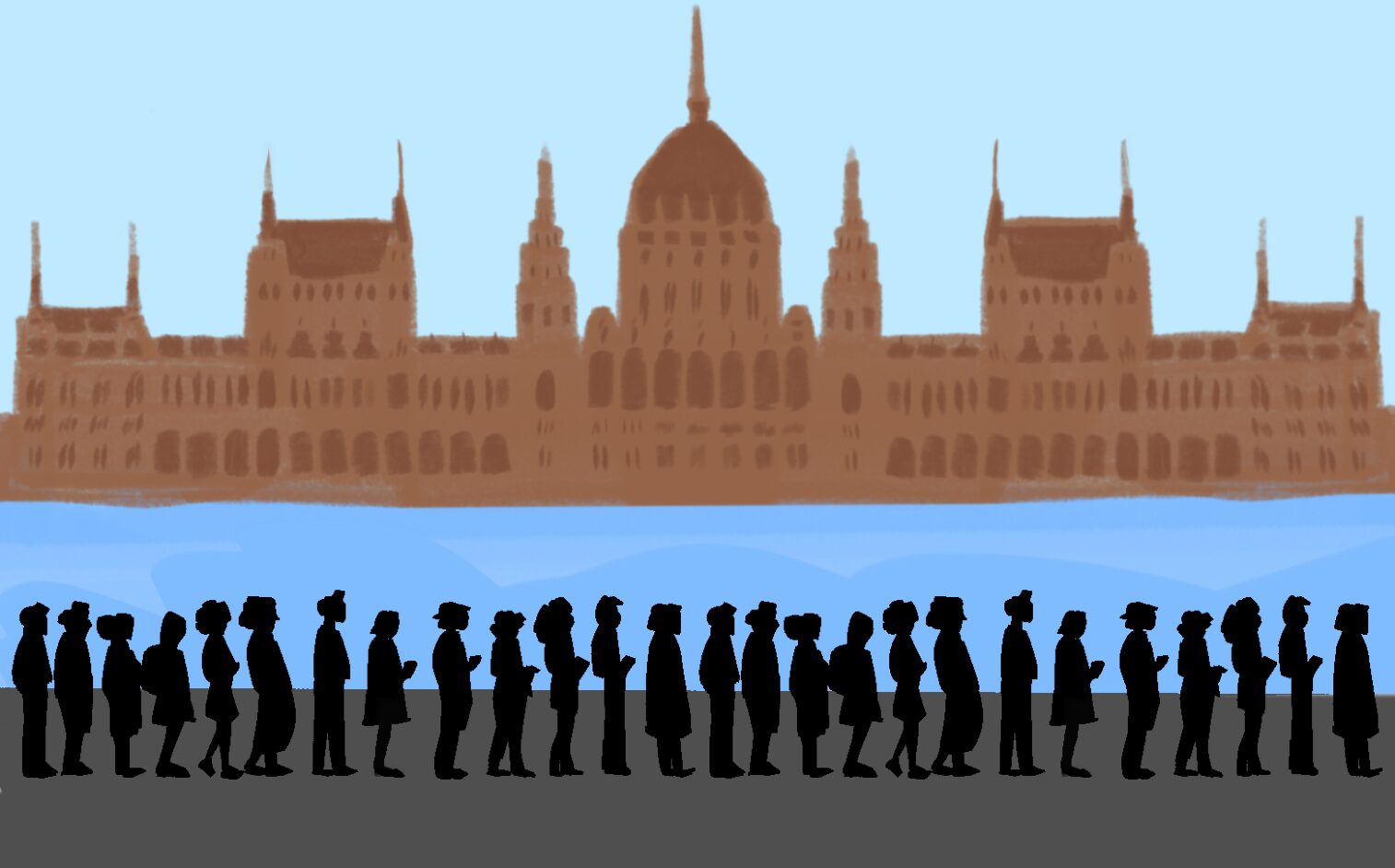
On Apr. 12, the most important elections in the European Union took place, according to the characterization made by Politico Europe: those for 199 members of the Hungarian National Assembly. More than 7.5 million Hungarians were expected to vote in a crucial parliamentary election for the country’s future, closely watched by the E.U., Washington and Moscow.
The race involved two very different parties and leaders. Fidesz, led by Viktor Orban and known for its conservative, nationalist policies and its friendship with Russia, competed against Tisza, a center-right party headed by Peter Magyar that focuses on fighting corruption and political accountability. Tisza was the first contender with a high chance of ending the Orban era, which held power for 12 years, according to polls.
The turnout was massive; half an hour before the polls closed, 77.8% of all voters had put their wish in a box, hoping that it would come true. The Hungarian press announced this as a record turnout; the last record was set in the 2002 parliamentary elections, when 70.53% of voters mobilized to decide the future of their country, Telex wrote.
However, the long queues extended beyond Budapest, as the diaspora of Hungarians living abroad followed the example of those remaining in their home country. In Haga, for example, the queue measured several dozen meters. The atmosphere was similar in London and Milan; in the latter, Nobel Laureate for literature Laszlo Kransznahorkai voted, after waiting two hours in line to express his opinion.
Pre-election polls indicated that Tisza would likely be supported by 48% of determined voters, while Fidesz was favored by only 40%. Such assumptions were not wrong, because the end of the Orban system was first announced by a Facebook post from Peter Magyar, in a short sentence on a dark blue background, “The Prime Minister has just congratulated us on the phone for our victory.”
Although only half of the votes had been counted by the time of the post, 9:11 p.m. in Hungary, many of those watching saw the historic victory of the opposition party Tisza as becoming evident.
Magyar’s post sparked hope among a notable number of Hungarians, as within ten minutes of its publication, people took to the streets to celebrate. Many in Hungary would not have believed it possible that after 16 years of autocratic rule involving election manipulation, systematic corruption, including favoritism toward government allies, and ideological control through government influence over the media, that the regime could change. At 9:20 p.m., the incumbent prime minister conceded defeat in a short speech to his supporters, saying that his party would work as the opposition in the future, but that “we will never give up. Never, never, never, and never.’’
Shortly after Orban’s speech, jubilant Hungarians, especially younger populations, gathered on the streets of Budapest and other cities across the country to celebrate the beginning of a new era and the end of the Orban regime. These kinds of scenes have been unparalleled since 1989-90, when the communist regime collapsed. The nation’s leading independent news platforms have noted the “end of arbitrariness’’ and the “collapse of the Orban order” or have shared short, simple sentences with strong messages such as “It’s over.’’
Magyar also gave a speech in front of thousands of supporters, which lasted 40 minutes and presented many promises. In an emotional, forward-looking speech Magyar stated that “From today the country lives again.” He also expressed his desire to transform Hungary into a nation fully engaged in the European continent, and a strong partner of NATO and the E.U. organizations, ideas with which the crowd strongly agreed. “We have received a historic mandate to build a functional and humane Hungary. We will work every minute and every moment to deserve this trust,’’ Magyar also proclaimed.
On the other hand, Magyar’s efforts to establish firmer ties with Europe may create greater effects for the country. University of Bucharest political scientist Luciana Ghica has argued that Magyar, upon winning the elections, “needs the support of Brussels, especially for the unblocking of European funds, to save the economy.’’
Written by Alexia Jarnea
Graphic by Sona Saravana
You may also like
-
The Metaverse Retreat: What Horizon Worlds’ Pivot Says About Meta’s Future
-
Hundreds Gather across MoCo for the Third No Kings Protest
-
Youth Social Media Bans Gain Momentum Across Countries
-
Photo Gallery: Northwood, Walter Johnson students unite against ICE
-
ICE Tipline prank reveals horrors of America’s immigration crackdown