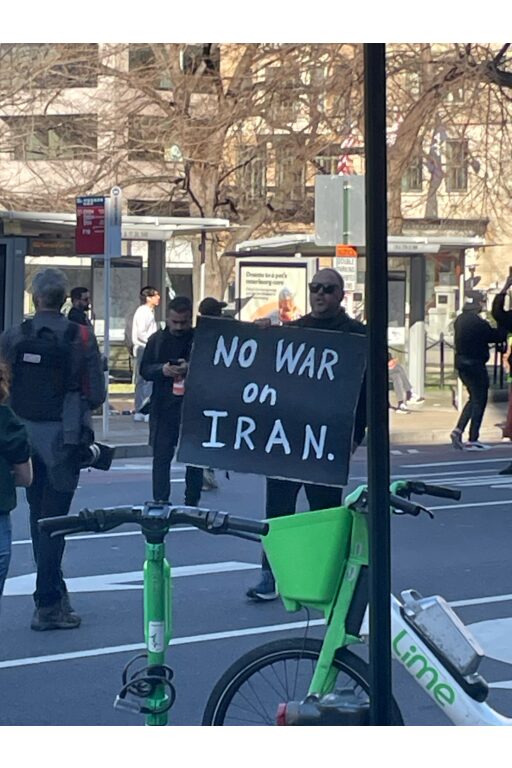
On Feb. 28, Iranians awoke to an Israeli airstrike on Tehran. Immediately after, Israeli Minister of Defense Israel Katz gave an announcement offering few details, saying that the purpose of the attack was “to eliminate threats.” The Israeli media reported that the operation, called Epic Fury, was launched jointly with the U.S. military. By 5 a.m. U.S. Eastern American time, dozens of strikes had been confirmed in seven cities in Iran.
This occurred after the latest round of intense negotiations between the U.S. and Iran, which took place in Geneva on Thursday. While the Foreign Minister of Oman, who functioned as a mediator, stated that “significant progress” had been made in technical discussions, the negotiations ended without any final agreement or decisive breakthrough.
Political analysts, on the other hand, emphasize that the negotiations were a cover up for plans to attack Iran. “There are specialists and military officials in Israel who say they agreed on this moment for several weeks,’’ Dean of Bucharest’s University of Political Studies and Public Administration Constantin Privulescu said. That means that the entire negotiation process was largely a camouflage for the preparation of this attack, which was intended to upend the regime.
In fact, officials have clearly expressed these hopes following the attack. President Trump stated on Saturday morning that the “objective is to defend the American people by eliminating imminent threats from the Iranian regime,’’ adding that “it has been the policy of the United States, in particular my administration, that this terrorist regime can never have a nuclear weapon.’’
Saturday’s military missions were divided: according to the BBC, the Americans targeted military bases and the Israelis attacked political leadership. In particular, The Times of Israel cited unofficial governmental sources suggesting that the strikes were an attempt to decapitate the State, the main targets being Supreme Leader Ayatollah Ali Khamenei and President Massoud Pezeshkian. The first visible attack took place right near the offices of Ayatollah Khamenei, and destroyed his residence. While Iranian officials and the press at first claimed that the spiritual leader was safe, President Trump and, later, Pezeshkian announced his death on Sunday around 2 a.m. in U.S. Eastern time, after more than eight hours of suspense.
Since the beginning of the conflict, strikes have killed and injured hundreds of Iranians, according to the Iranian Red Crescent Society. Per the media arm of the Revolutionary Guards, an unidentified missile attack on a girls’ school in southern Iran left between 20 and 40 girls dead. There are no independent sources to verify this news. The location of the attack was a strategic one, allowing control of the Strait of Hormuz, through which about 20% of global oil passes and where several Iranian bases are located.
Tehran’s answer was quick as the Foreign Minister classified the attacks as a violation of the UN charter, and called on all states, especially the Islamic nations, to condemn the aggression. “The armed forces of the Islamic Republic of Iran… will not hesitate to defend our beloved homeland with all their strength,’’ he said. Shortly before Israel announced a nation-wide alert about Iranian missiles, the Head of the Tehran Parliament’s Security Committee also said, “I warned you. Now you are on a path whose outcome no longer depends on you.’’
Israel’s population has also had to adapt their lifestyle after the military attacks in order to remain safe, even if it means upsetting their entire schedule. Thomas S. Wootton High School junior Abby Siegel, currently located in Israel, said, “I’ve spent the majority of many days in bomb shelters; we have resorted to sleeping in bomb shelters because of the red alerts that constantly go off at night.’’
“My daily life has changed pretty drastically… I don’t feel unsafe here, though I feel that Israeli defenses are very strong due to the unfortunate truth that it is often the target of many different attacks,’’ Siegel explained. Hezbollah terrorists attacked Israel once again on Monday, leading Israel to retaliate against them in Lebanon.
The confirmation of America’s involvement came from President Donald Trump himself, who posted a video on his own platform Truth Social in which he mentioned that the U.S. launched, “a major combat operation.” He did not spare from giving advice, instructing the Iranian people to stay sheltered and take control of their government after the end of the attack. “[The government] will be yours. This will probably be your only chance for generations,’’ stated the head of the White House.
Israeli Prime Minister Benjamin Netanyahu expressed similar statements. “Israel and the United States have embarked on this operation to eliminate the existential threat posed by the terrorist regime in Iran. I thank our great friend President Donald Trump for his historic leadership,” he said.
Iran has continued to retaliate against the surrounding countries, turning tensions into a local conflict. Iranian attacks have been reported in Dubai, Abu Dhabi, Bahrain, Qatar, Kuwait and Jordan, countries where important American bases are located; however, only one base in Bahrain was hit. In Israel, air raid sirens have warned the population of Iran sending ballistic missiles; the strikes have led to over ten deaths. Notably, a Tel Aviv apartment building partially collapsed, which has led to authorities announcing one death and more than 120 injured individuals.
Following the attacks, the aforementioned countries have imposed travel restrictions, leading tourists to be held in airports after flights were canceled on a large scale. In Dubai, thousands of people are now waiting to return home safely after the airport suffered damage to a terminal following an Iranian strike; there have been five casualties.
European responses did not take long to appear. Great Britain, which is considered one of the closest allies of the U.S., declared on Saturday that Iran should never be permitted to develop nuclear weapons. On Sunday, Iranian drones hit a British base in Cyprus, Starmer has only permitted the United States to use British bases for “a specific and limited defensive purpose,” despite the historically close relations between the UK and U.S..
French President Emmanuel Macron solicited a general meeting of the National Security Council, stating that France was neither aware of nor involved in the plans and that the outbreak of war between the U.S., Israel and Iran has serious consequences for international peace and security.
If the current Iranian leadership is to be replaced after these strikes, the effects would extend beyond the country. Iran plays a major role in Middle Eastern politics and supports terrorist groups around the region such as Hezbollah, affecting the security decisions of countries like Israel, Saudi Arabia and the U.S.
Despite this, the opinions of American citizens remain divided, and many people do not know which side to take as their wish of peace is not a current possibility. “Peace is the most precious good that humans can experience, and knowing that people on this earth are dying and suffering disturbs my calm,’’ Bethesda-Chevy Chase High School junior Raisa Raucea said.
Written by Alexia Jarnea
Photo courtesy of Alexia Jarnea
You may also like
-
Trump Administration Continues Overhaul of Travel and Immigration Policy
-
166-million-year-old ‘Dinosaur Highway’ discovered in England
-
Photo Gallery: Walter Johnson High School Anti-ICE Walkout
-
A Campus Shaken: The December 13 Shooting at Brown University
-
Eight Decades Since the Beginning of the Denunciation of Crimes Against Humanity: The Nuremberg Trials